

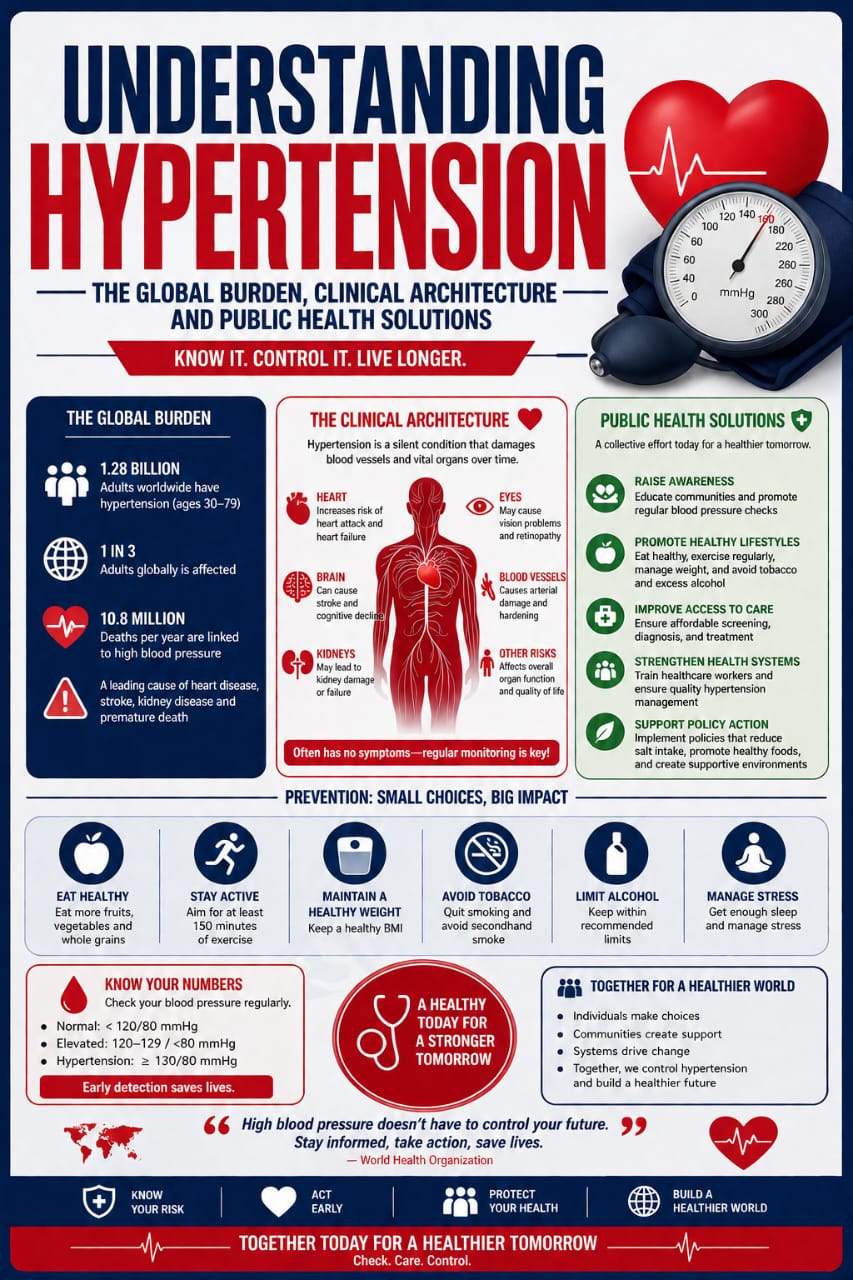
Written In alignment with the World Health Organization (WHO) Global Report on Hypertension
Introduction
Hypertension is the leading preventable risk factor for cardiovascular disease, chronic kidney disease, and premature mortality globally. Often referred to as the “silent killer,” this condition is defined by a persistent elevation of systemic arterial pressure, frequently remaining asymptomatic until severe organ damage occurs.
According to data compiled by the World Health Organization (WHO), the number of individuals living with hypertension worldwide doubled from 650 million in 1990 to 1.3 billion. This surge severely impacts global healthcare infrastructure and presents a critical barrier to achieving United Nations Sustainable Development Goal (SDG) Target 3.4, which aims to reduce premature mortality from non-communicable diseases by one-third by 2030
1. History of Hypertension Research
The understanding of blood pressure has evolved over millennia from ancient concepts of systemic balance to modern cardiovascular science.
- Ancient Conceptions: Early Chinese and Greek medical texts, including the works of Galen, identified pulse characteristics linked to hard pulse disease, frequently prescribing bloodletting to reduce systemic fullness.
- The Discovery of Circulation: In 1628, William Harvey described the circulatory properties of the human heart, laying the groundwork for hemodynamics.
- The First Measurement: In 1733, Stephen Hales achieved the first quantitative measurement of blood pressure by inserting a glass tube into the artery of a horse.
- The Sphygmomanometer: Scipione Riva-Rocci invented the mercury sphygmomanometer in 1896, which Nikolai Korotkoff refined in 1905 by describing the auditory phases used in modern clinics.
- The Therapeutic Breakthrough: It was not until the mid-20th century, following the premature death of US President Franklin D. Roosevelt from a hypertensive stroke, that public health shifted from viewing high blood pressure as a natural consequence of aging to a treatable disease.
2. Clinical Definition and Diagnostic Classification
Systemic blood pressure is quantified by two clinical metrics: systolic blood pressure (SBP), which measures the force exerted on arterial walls during ventricular contraction, and diastolic blood pressure (DBP), which reflects arterial pressure during ventricular relaxation.
International diagnostic frameworks establish precise thresholds for identifying and managing hypertension:
- World Health Organization (WHO) Protocols: Clinical hypertension is diagnosed in adults when SBP is ≥ 140 mmHg and/or DBP is ≥ 90 mmHg, confirmed across at least two independent clinical evaluations on separate days.
- ACC/AHA Collaborative Framework: The American College of Cardiology and the American Heart Association utilize a stratified, four-tier classification system:
- Normal: SBP < 120 mmHg and DBP < 80 mmHg.
- Elevated: SBP 120–129 mmHg and DBP < 80 mmHg.
- Stage 1 Hypertension: SBP 130–139 mmHg or DBP 80–89 mmHg.
- Stage 2 Hypertension: SBP ≥ 140 mmHg or DBP ≥ 90 mmHg.
To minimize diagnostic distortions such as “white-coat hypertension” or masked hypertension, modern guidelines recommend validating clinical readings through Ambulatory Blood Pressure Monitoring (ABPM) or standardized Home Blood Pressure Monitoring (HBPM).
3. Etiology and Pathogenesis
Hypertension is a multifactorial disorder arising from a complex interplay of genetic predispositions, environmental exposures, and physiological anomalies. It is etiologically classified into two primary forms:
Primary (Essential) Hypertension
Essential hypertension accounts for approximately 90% to 95% of all adult cases. It develops insidiously over time without a singular, identifiable underlying medical cause. Its principal drivers include:
- Excessive Sodium Intake: High dietary sodium disrupts renal fluid regulation, expands extracellular fluid volume, and increases cardiac output.
- Physical Inactivity and Obesity: Sedentary lifestyles stimulate the sympathetic nervous system and promote insulin resistance, which elevates vascular resistance.
- Substance Use: Chronic exposure to tobacco and high alcohol intake damages endothelial linings, induces vasoconstriction, and stiffens large arteries.
- Advanced Age and Genetic Predisposition: Natural vascular aging causes a progressive loss of arterial elasticity, compounding inherited polygenic vulnerabilities. Secondary Hypertension
Accounting for the remaining 5% to 10% of diagnoses, secondary hypertension is characterized by an abrupt onset directly attributable to an underlying medical condition. Common causes include renal parenchymal disease, renovascular stenosis, obstructive sleep apnea, primary aldosteronism, and Cushing syndrome, as well as the use of oral contraceptives or specific over-the-counter medications.
4. Holistic Impact: Physical, Mental, and Spiritual Health
Modern public health frameworks increasingly view hypertension through a holistic paradigm, recognizing that cardiovascular disease strains the physical, psychological, and spiritual dimensions of human wellness.
Physical Health and Pathophysiology
Chronic arterial hypertension exerts continuous mechanical stress on the vascular endothelium, triggering microvascular and macrovascular injuries while accelerating atherosclerosis. The physical progression begins with chronic tension causing arterial degradation. This vascular compromise leads directly to myocardial infarction or heart failure. Concurrently, elevated pressure exerts severe cerebrovascular shear stress, causing ischemic or hemorrhagic strokes. At the microvascular level, the kidneys suffer glomerular damage leading to chronic kidney disease (CKD), while retinal vascular degeneration leads to hypertensive retinopathy and permanent visual impairment.
Mental Health and Cognitive Decline
The relationship between hypertension and neuropsychiatric health is reciprocal:
- Chronic Neurosis and Stress: Elevated cortisol and adrenaline from prolonged anxiety, systemic discrimination, or socioeconomic stress activate the sympathetic nervous system, inducing sustained arterial vasoconstriction.
- Vascular Dementia: Chronic hypertension inflicts subclinical damage on the brain’s white matter, accelerating cognitive decline, memory impairment, and executive dysfunction.
- Psychological Burden: Navigating a lifelong chronic diagnosis often increases rates of clinical depression and anxiety, which complicates a patient’s ability to maintain treatment adherence.
Spiritual Health, Connection, and Mindfulness
While spiritual health is distinct from clinical medicine, public health studies observe that a person’s inner state profoundly affects their physiology.
- The Biology of Peace: Spiritual practices centered on meditation, prayer, forgiveness, and community belonging lower systemic inflammation and downregulate the body’s fight-or-flight response.
- Existential Distress: Conversely, deep-seated spiritual or existential crises—such as a lack of purpose, chronic resentment, or profound isolation—can manifest as chronic physiological stress, exacerbating vascular trend.
5. Scriptural and Historical Wellness Connections
Ancient wisdom traditions and scriptural texts long predicted the mind-body connections verified by modern epidemiology, advocating for temperance, peace, and dietary mindfulness.
- The Mind-Body Axis: Christian scriptures explicitly connect emotional states with biological vitality. Proverbs 14:30 notes that “A tranquil heart gives life to the flesh, but envy makes the bones rot,” aligning with modern observations on how chronic stress drives cardiovascular damage. Similarly, Proverbs 17:22 states that “A joyful heart is good medicine, but a crushed spirit dries up the bones.”
- Dietary Stewardship: Scriptural directives often emphasize physical temperance and specific structural limits on consumption. In Leviticus 3:17, the mandate to avoid eating fat or blood reflects an early cultural awareness of cardiovascular moderation. In the Islamic tradition, a well-known Hadith (Sunan al-Tirmidhi 2380) advises that a human fills no vessel worse than their stomach, advocating for eating in moderation to protect physical well-being.
- Sabbath and Rest: The scriptural institution of a mandatory day of rest (Exodus 20:8-10) serves as an early structural intervention against chronic stress and physical exhaustion, actively protecting the cardiovascular system from the damage of uninterrupted labor.
6. Global Public Health Strategies and Control Measures
Despite the global availability of highly effective, low-cost generic antihypertensive therapies, the rate of uncontrolled hypertension remains critical at 54.6%. Approximately 80% of individuals with hypertension do not have their blood pressure adequately managed, a gap that is most pronounced in low- and middle-income countries (LMICs).
To address this treatment gap, the WHO promotes the widespread implementation of the HEARTS technical package within primary healthcare systems. This evidence-based framework relies on five fundamental pillars:
- Standardized Treatment Protocols: Establishing simplified, stepwise drug titration algorithms to reduce therapeutic inertia and streamline clinical care.
- Access to Essential Medicines: Securing consistent, affordable supplies of core antihypertensive classes, including ACE inhibitors, Angiotensin Receptor Blockers (ARBs), and Calcium Channel Blockers (CCBs).
- Team-Based Care: Shifting routine monitoring, patient counseling, and titration adjustments from physicians to trained community nurses, pharmacists, and allied health workers.
- Patient-Centered Education: Empowering patients through clear counseling on lifestyle modifications, specifically dietary sodium reduction, smoking cessation, and strict medication adherence.
- Information Systems: Utilizing robust digital health registries to track patient progress, monitor clinic-level control rates, and improve long-term care continuity.
The Human and Economic Impact
Investing in comprehensive hypertension control offers exceptional returns for global public health. Epidemiological modeling indicates that expanding effective treatment coverage to 50% globally could prevent an estimated 76 million premature deaths by 2050. Furthermore, achieving this target would reduce global healthcare expenditures and productivity losses by approximately USD 100 billion annually, making hypertension control one of the most cost-effective interventions available for non-communicable diseases.

