

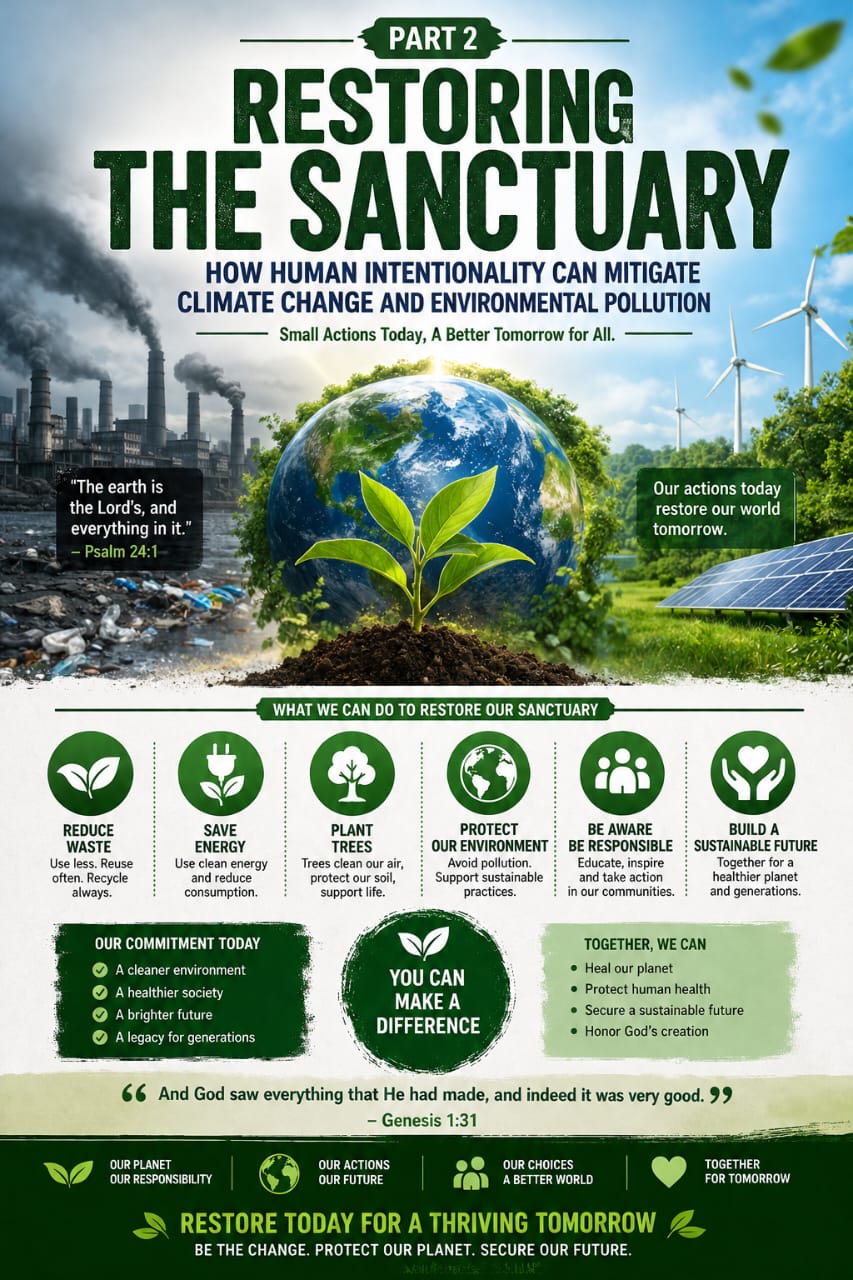
Part 2: Restoring the Sanctuary: How Human Intentionality Can Mitigate Climate Change and Environmental Pollution
In Part 1 of this series we exposed how environmental decay fractures human biology, psychology, and spiritual peace, Part 2 of this series provides the remedy. Recognizing a crisis is meaningless without a deliberate, organized framework for action. Reclaiming a healthy society demands an aggressive shift from passive awareness to active, intentional mitigation. Human ingenuity and collective discipline can halt the destruction of the biosphere, offering a realistic pathway to heal the human body, mind, and spirit by restoring the earth
A Brief History of Environmental Action and Restoration
Humanity’s effort to intentionally protect the environment is not a modern phenomenon, though its structural framework has evolved significantly. For centuries, traditional agrarian societies practiced natural conservation out of raw survival and spiritual reverence, using rotational farming, sacred forest preservation, and natural watershed protections. However, formal modern environmentalism was truly ignited in 1962 by the publication of Rachel Carson’s Silent Spring, which exposed the devastating impact of synthetic pesticides on global ecosystems. This milestone catalyzed the first global Earth Day in 1970 and led to the establishment of major regulatory bodies like the United States Environmental Protection Agency (EPA).
Internationally, this momentum culminated in landmark treaties, from the 1987 Montreal Protocol—which successfully phased out ozone-depleting chlorofluorocarbons (CFCs)—to the 2015 Paris Agreement, a historic global commitment to limit global warming to well below 2 degrees Celsius.
In Nigeria, institutional environmental action began taking structural shape following the toxic waste dumping scandal in Koko, Delta State, in 1988, which prompted the immediate formation of the Federal Environmental Protection Agency (FEPA), later transitioning into the National Environmental Standards and Regulations Enforcement Agency (NESREA). Today, grassroots movements across Nigeria, such as youth-led reforestation drives in the semi-arid north and plastic recovery coalitions in Lagos, mark a vital historical transition: environmental defense has shifted from top-down international paperwork to direct, intentional
Actionable Strategies for Intentional Human Mitigation
To systematically reverse planetary degradation, intentional human action must be deployed across local, structural, and institutional levels.
1. Transitioning to Clean Energy and Decarbonization
The most critical structural step is the deliberate dismantling of fossil-fuel dependence. Communities and nations must aggressively invest in decentralized solar, wind, and hydroelectric power grids. For individual households and businesses, this means intentionally phasing out high-emission diesel and petrol generators in favor of solar inverter systems, directly lowering the atmospheric load of toxic gases and particulate matter.
2. Embracing Circular Economies and Closed-Loop Waste Management
Humanity must move away from the destructive “take-make-waste” linear model of production. True mitigation requires establishing circular economies where products are intentionally designed for complete reuse, recycling, or composting. On a personal level, this involves reducing single-use plastics, participating in localized waste-sorting programs, and supporting industries that utilize closed-loop manufacturing to keep chemical pollutants out of groundwater tables.
3. Reforestation and Sustainable Agriculture
Trees are the planet’s natural carbon sinks and air purifiers. Intentional reforestation efforts, such as Africa’s massive Great Green Wall initiative, help halt desertification while actively filtering ambient air. Accompanying this is the shift toward agroecology—farming methods that eliminate synthetic chemical fertilizers and pesticides, relying instead on crop rotation, organic composting, and natural pest management to preserve soil vitality.
4. Urban Green Infrastructure and Active Commuting
Municipalities must intentionally integrate nature into urban design. Expanding urban canopy covers, creating green rooftops, and constructing designated pedestrian and cycling lanes help mitigate the dangerous “urban heat island” effect. Choosing public transit, carpooling, or active walking directly reduces localized vehicular emissions, instantly improving urban air quality.
The Whole-Person Healing Cascade:
Body, Mind, and Spirit
When humans intentionally intervene to clean the environment, the benefits extend far beyond carbon metrics; it triggers an immediate, systemic healing process across the entire
human experience.
Physiological Recovery
- Cardiovascular and Respiratory Relief: As clean energy and emission controls reduce atmospheric PM 2.5 and ground-level ozone concentrations, systemic vascular inflammation decreases. Rates of acute asthma attacks, chronic obstructive pulmonary disease (COPD) flare-ups, and ischemic heart diseases drop rapidly.
- Detoxification of the Food Chain: Enforcing strict industrial waste and wastewater treatments halts heavy metal and microplastic accumulation in marine and agricultural systems. The gastrointestinal tract and endocrine systems recover, reducing rates of chemical-induced metabolic mutations and toxic organ stress.
Psychological Restoration
- Alleviation of Eco-Anxiety: Shifting from passive helplessness to active, organized environmental problem-solving has a profound therapeutic effect Engaging in community cleanups or climate advocacy helps replace feelings of existential despair and climate depression with a sense of agency, efficacy, and hope
- Neurological Calming via Green Spaces: Direct immersion in restored, clean natural environments—often clinically termed “nature therapy” or shinrin-yoku—is proven to rapidly lower cortisol levels, stabilize heart rates, and reduce blood pressure. It counters urban-induced neuro-inflammation, restoring concentration, short-term memory, and emotional balance.
Spiritual Alignment and Fulfillment of Purpose
- Restoration of Sacred Harmony: Cleaning up polluted rivers and protecting threatened forests is a profound act of spiritual restoration. For indigenous and traditional communities, reclaiming the purity of these ecosystems restores the sacred bond between the visible community and ancestral spaces, bringing back a deep sense of identity and peace.
- Activating Abrahamic Stewardship and Khalifah: For Christian and Islamic believers, taking deliberate steps to preserve the earth is the highest expression of active faith. It transforms theoretical doctrine into daily obedience. In Christianity, picking up waste, planting trees, and reducing consumption directly satisfies the Edenic mandate to keep and dress God’s creation (Genesis 2:15), turning ecological action into an act of true worship. In Islam, environmental mitigation satisfies the holy responsibility of being a true trustee (Khalifah) on earth. It actively maintains the cosmic, divinely engineered balance (Mizan) of creation, aligning the believer with the cosmic order
Verifiable Institutional Progress Indicators
To understand the immense power of intentional human intervention, data from global authorities proves that environmental mitigation yields clear, measurable success:
- The World Health Organization (WHO): Epidemiological models prove that enforcing strict air quality guidelines globally could prevent an estimated 4 to 5 million air-pollution-related deaths annually, while drastically reducing global healthcare expenditures linked to chronic cardiopulmonary treatment
- The United Nations Environment Programme (UNEP): Documented case studies show that local communities utilizing circular economy frameworks have successfully diverted up to 70% of municipal plastic waste from landfills and waterways, rapidly restoring local aquaculture health and protecting human food security.
- The Intergovernmental Panel on Climate Change (IPCC): Scientific assessments state that immediate, deep emission reductions across all economic sectors can successfully stabilize global temperatures. This mitigation would shield hundreds of millions of people from severe heat waves, catastrophic flooding, and vector-borne disease outbreaks by the mid-2030s.
Conclusion
The state of our health is a direct mirror of the state of our environment. We cannot sustain a healthy society if we continue to tolerate toxic ecosystems. Climate change and pollution are monumental crises, but they are entirely human-made, meaning they can be entirely human-corrected.
True ecological restoration requires a unified, intentional effort from every layer of society. When families minimize waste, when universities pioneer clean-energy campuses, when faith communities champion environmental stewardship, and when policymakers strictly enforce ecological laws, we are doing more than saving trees—we are saving ourselves
By taking intentional care of the planet, we fulfill our highest spiritual calling, protect our psychological well-being, and shield our physical bodies from disease. Reclaiming public health demands that we treat the preservation of our environment as the ultimate act of preventative medicine, ensuring a vibrant, thriving world for generations to come.
1 Corinthians 10:31 (KJV): “Whether therefore ye eat, or drink, or whatsoever ye do, do all to the glory of God.”
Protecting, preserving, and restoring the earth is the ultimate way to fulfill this scriptural standard, transforming our daily relationship with creation into a living testament of honor to the creator.

