

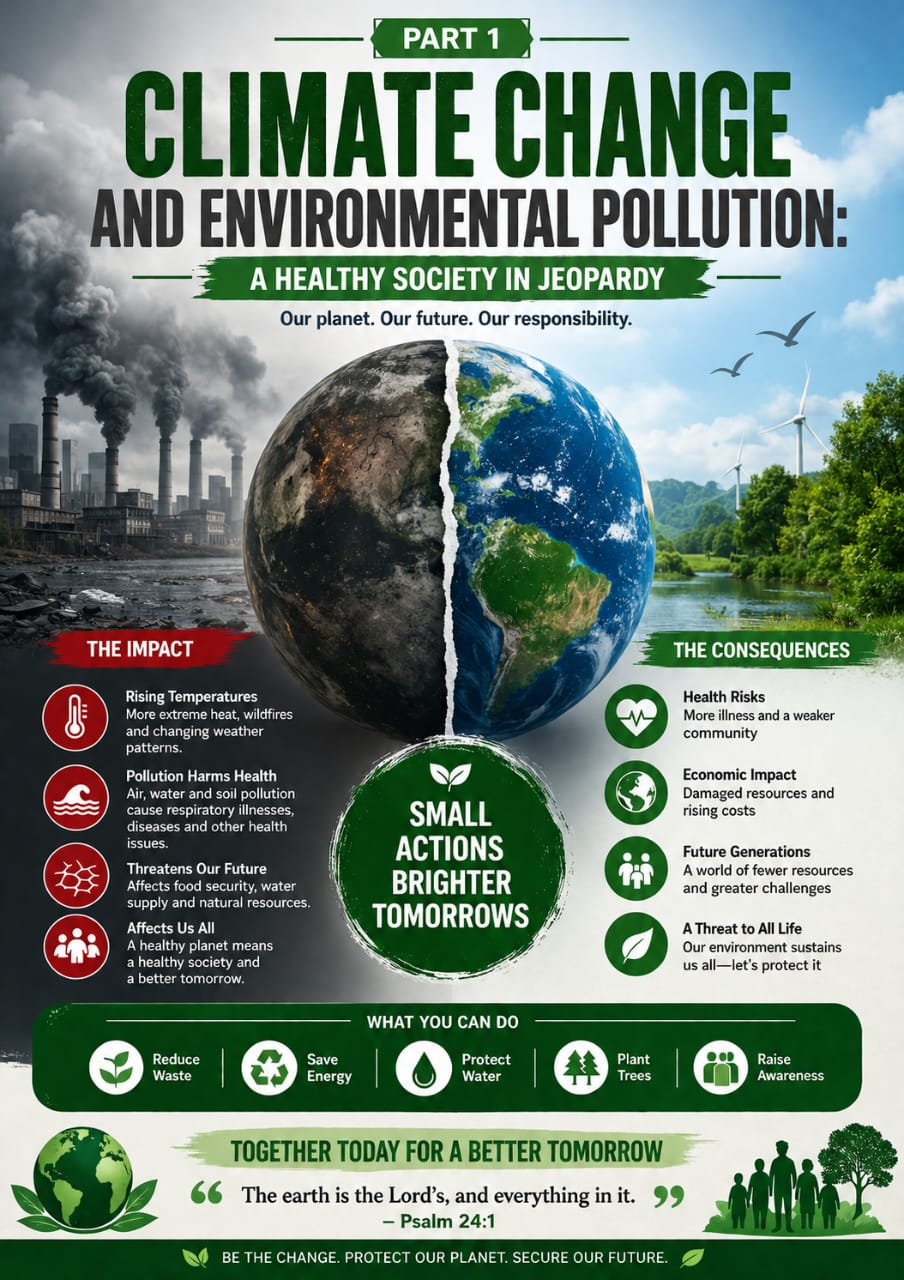
Part 1: Climate Change and Environmental Pollution: A Healthy Society in Jeopardy
Public health has historically been measured by healthcare accessibility, nutritional intake, and pharmaceutical advancement. However, a foundational reality is fast overtaking these metrics: a society can only be as healthy as the environment in which it resides. Across Nigeria and the global landscape, the dual crises of climate change and environmental pollution are no longer distant ecological threats. They are active, systemic forces aggressively undermining human biology, degrading psychological resilience, shattering spiritual harmony, and threatening to collapse public health infrastructures
A Brief History of Anthropogenic Ecocide
Environmental transformation is deeply woven into human history, but its scale changed drastically during the Industrial Revolution of the 18th century. For millennia, agricultural societies lived in relative equilibrium with natural systems, relying on organic waste cycles and renewable energy source dynamics. The invention of the coal-fired steam engine and the subsequent mass exploitation of fossil fuels fundamentally broke this balance. Factories and emerging urban centers began discharging unprecedented volumes of sulfur dioxide, carbon monoxide, and untreated industrial waste into shared ecosystems, prioritizing economic expansion over ecological stability.
In West Africa, and specifically across Nigeria, this environmental shift accelerated dramatically in the mid-20th century. The discovery of crude oil in the Niger Delta in 1956 transformed the nation into a global petro-state, but it brought severe ecological devastation. Decades of unmitigated gas flaring, oil spills, and rapid, unregulated urban migration into cities like Lagos completely altered regional environmental baselines. What were once pristine, self-sustaining mangrove forests and highly fertile agricultural fields gradually became toxic zones. This historical shift tied local economic livelihood directly to structural practices that systematically poison the air, water and land.
The Planetary Toll: Structural Drivers and Atmospheric Mechanics
- Air Quality Degradation and Thermal Inversion
Industrial emissions, vehicular exhaust, and the burning of fossil fuels release vast quantities of particulate matter PM 2.5 and PM 10, sulfur dioxide (SO2), and nitrogen oxides( NO) into the troposphere. This pollution is severely compounded by climate change:
- Rising Surface Temperatures: Increased ambient heat accelerates the photochemical reaction of volatile organic compounds, yielding high concentrations of ground-level ozone , a severe respiratory irritant.
- Thermal Inversion Layers: Warmer atmospheric caps trap dense pockets of toxic smog close to the surface, forcing urban populations to continuously inhale concentrated particulate matter.
2. Ecosystem Disruptions and Vector Shifts
Shifting meteorological patterns alter geographic and ecological baselines, creating ideal proliferation environments for deadly pathogens and disease vectors:
- Expanded Vector Habitats: Rising temperatures and erratic precipitation expand the breeding windows and geographical latitudes for Anopheles (malaria) and Aedes (dengue/yellow fever) mosquitoes.
- Extreme Hydrological Events: Severe flooding events systematically mix municipal sewage with open water tables, causing immediate, widespread bacterial contamination of drinking water supply.
Verifiable Institutional Statistics on Global Health Impact
- The World Health Organization (WHO): Ambient and household air pollution combined is directly responsible for an estimated 7 million premature deaths globally each year. Furthermore, the WHO projects that between 2030 and 2050, climate change will cause approximately 250,000 additional deaths per year from malnutrition, malaria, diarrhea, and heat stress alone.
- The United Nations Environment Programme (UNEP): Global monitoring confirms that over 80% of urban wastewater is discharged untreated into rivers and oceans. This triggers severe heavy metal and microplastic bioaccumulation within the food chain, systematically poisoning communities dependent on local aquaculture.
- The Lancet Commission on Pollution and Health: Environmental pollution remains the world’s single largest environmental cause of disease and premature death, responsible for an estimated 9 million deaths annually. This represents roughly 16% of all global mortalities, three times more deaths than from AIDS, tuberculosis, and malaria combined.
The Deep Physiological Toll: Pathological Cascades
- The Respiratory System: Inhaled PM2.5 bypasses the lung’s natural filtration mechanisms, penetrating deep into the alveoli. This triggers chronic obstructive pulmonary disease (COPD), severe asthma exacerbations, and cellular mutations culminating in pulmonary carcinomas.
- The Cardiovascular Network: Fine particulate matter moves directly from the lungs into the bloodstream, provoking systemic vascular inflammation. This biological stress accelerates arterial plaque buildup, drastically spiking the incidence of ischemic heart disease, cardiac arrhythmias, and strokes.
- The Gastrointestinal and Metabolic Tracts: Microplastics and chemical heavy metals (such as lead and mercury) ingested through contaminated seafood and groundwater cause severe internal damage. They disrupt the gut microbiome, trigger chronic mucosal inflammation, and act as endocrine disruptors that damage metabolic and reproductive health.
- The Immunological Complex: Continuous exposure to toxic environmental stressors keeps the human immune system in a perpetual state of hyper-activation. This chronic systemic inflammation exhausts the body’s natural defense mechanisms, leaving individuals highly susceptible to opportunistic viral and bacterial infections.
The Psychological Toll: Neuro-Inflammation and Eco-Anxiety
The psychological damage inflicted by a degrading biosphere is deeply tied to physical brain pathology. Inhaled ultrafine particulate matter can cross the blood-brain barrier, triggering localized neuro-inflammation. Clinical studies indicate that chronic exposure to highly polluted environments is linked to a rise in neurodegenerative disorders, cognitive decline in young adults, and an increase in general depressive and anxiety states.
Beyond the direct biological pathways, the climate crisis exerts an immense mental health burden through existential stress, widely classified as eco-anxiety. Young people across the globe experience an overwhelming sense of helplessness, grief, and fear regarding an uncertain future on a warming planet.
For communities facing immediate displacement due to desertification in northern Nigeria or coastal erosion in southern shorelines, this mental stress escalates into full post-traumatic stress disorder (PTSD), severe depression, and widespread displacement trauma. The loss of stable environmental parameters systematically strips individuals of their fundamental baseline of security.
The Spiritual Toll: Broken Interconnectedness and Stewardship Deficits
Spiritual health relies fundamentally on a sense of harmony, connection, and balance with the surrounding creation and the Creator. Environmental destruction disrupts this vital alignment, creating a profound state of spiritual alienation and existential emptiness.
The Corruption of Indigenous Sacred Spaces
In many traditional African spiritualities, nature is not viewed merely as a resource to exploit, but as a living sanctuary. Forests, rivers, and mountains are historically revered as sacred spaces or resting places for ancestral spirits. When oil spills poison ancestral waters or commercial logging decimates historic woodlands, it represents more than economic loss; it is an act of spiritual desecration. This destruction severs the metaphysical connection between a community and its ancestral identity, leaving individuals spiritually unanchored.
The Violation of Abrahamic Stewardship
Both Christian and Islamic theological frameworks place a heavy responsibility on humanity to act as caretakers of the Earth.
- The Biblical Mandate: Scripture establishes that the earth belongs to God and humans are assigned as holy stewards to keep and care for it (Genesis 2:15). The systematic pollution of the earth for greedy commercial gain directly violates this mandate, turning divine stewardship into reckless exploitation. This ongoing destruction creates an underlying spiritual guilt, clouding a believer’s fellowship with the Creator.
- The Islamic Principle of Khalifah: Islamic jurisprudence establishes humanity as trustees or vicegerents (Khalifah) over creation. The Prophet Muhammad taught that the world is green and beautiful, and God has appointed humanity as stewards over it. The destructive overconsumption and reckless waste-dumping that drive climate change directly violate this sacred trust, distorting the cosmic balance (Mizan) established by God.
When young people watch the global environment decay due to human greed, it drives a quiet spiritual conflict. It weakens active prayer and meditative focus, replaces inner peace with existential despair, and creates a painful gap between humanity’s present-day greed and the1 divine blueprint for a well-ordered, protected creation.
Final Thoughts
The ecological crisis is fundamentally a complete human crisis, breaking down the body, mind, and spirit simultaneously. Climate change and environmental pollution do not merely degrade the natural landscape; they directly compromise the cellular, cardiovascular, psychological, and spiritual integrity of human populations. Treating the symptoms of eco-driven illnesses within hospital walls is a losing battle if the air we breathe, the water we drink, and the soil we cultivate remain systematically toxic.
A healthy society cannot exist on a dying planet. Recognizing this interconnected breakdown is a vital first step. To save public well-being, we must stop viewing the planet as an infinite trash bag and start treating environmental health as the ultimate form of preventative medicine.

